
Get more content that can help you
Content
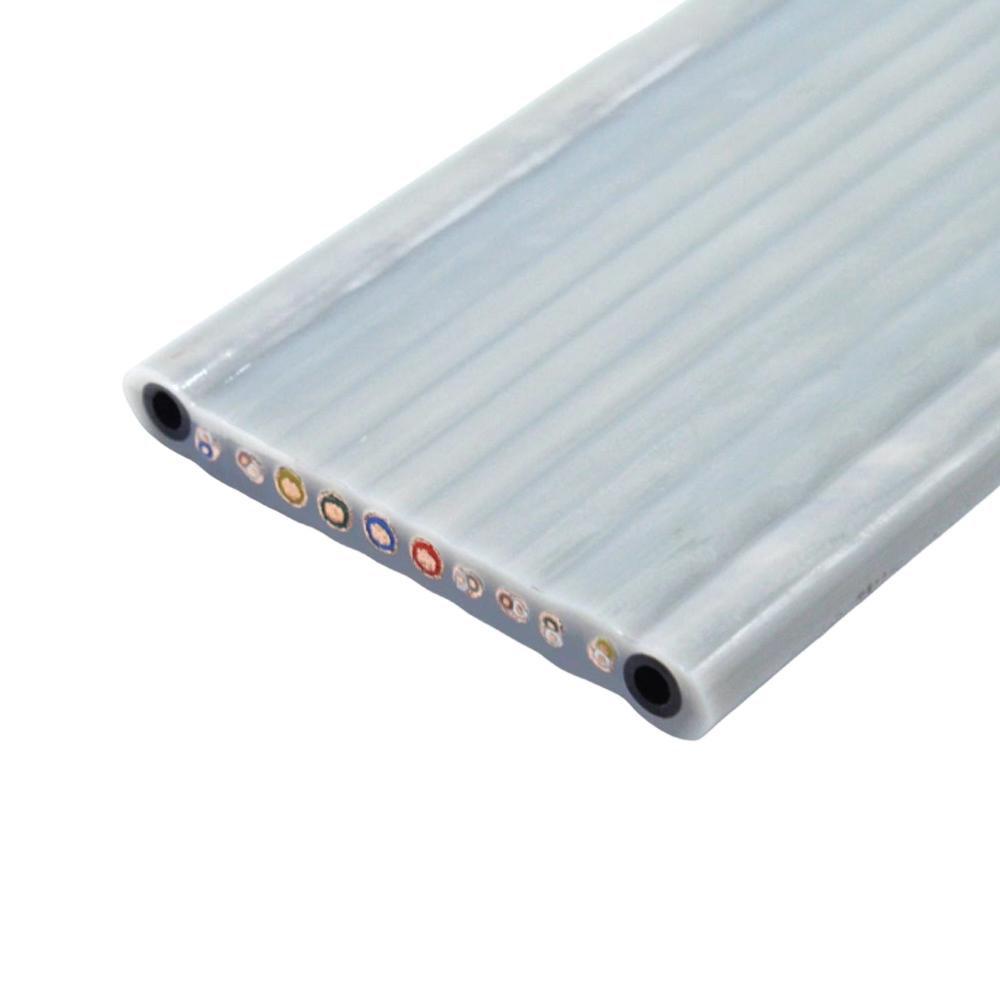
An elevator traveling flat cable, also called a trailing flat cable, is the flexible connection that links the moving elevator car to fixed points in the machine room or hoistway, typically at the top or bottom of the shaft. It carries power for car lighting and fans, control signals for the car's operating panel, intercom and emergency communication lines, and in many modern systems, video signals for in-car surveillance. Because the car moves continuously up and down while the cable remains anchored at a fixed point, the cable must bend and flex repeatedly over its service life without losing electrical continuity or mechanical strength. This constant motion, rather than static installation, is what separates trailing flat cables from nearly every other type of building wiring and drives most of the specialized engineering behind them.
The flat, ribbon-like cross-section of these cables is not simply a design preference; it directly addresses the mechanical realities of elevator shafts. A flat profile distributes bending stress evenly across the cable's width during each up-and-down cycle, which reduces the risk of internal conductor fatigue compared to round cables that tend to twist under repeated motion. This shape also fits neatly into the cable tray or trailing cable rack mounted along the shaft wall, keeping the cable arranged in a predictable path rather than swinging freely, which would increase the chance of snagging, abrasion against shaft components, or contact with moving machinery.
Selecting a trailing flat cable involves evaluating several interconnected performance factors, since a weakness in any single area can compromise the entire elevator system's reliability. Facility managers, elevator contractors, and specifiers benefit from understanding these requirements even if they are not engineers, because it allows for more informed conversations with cable suppliers and installers.
| Performance Factor | Why It Matters | Typical Benchmark |
| Dynamic Bending Life | Determines how long the cable lasts under repeated motion | Over 1 million bending cycles |
| Tensile Strength | Supports the cable's suspended weight and dynamic loads | Reinforced with aramid fiber elements |
| Flame Retardancy | Prevents fire and toxic smoke spread in the shaft | Compliant with EN 50265 or IEC 60332 |
| Signal Shielding | Protects control and video signals from interference | Foil or braided shielding with drain wire |
The way a trailing flat cable is internally reinforced affects both its bending performance and its long-term durability, and buyers should understand the difference between the two most common approaches used by manufacturers.
In this traditional approach, aramid yarn is positioned at the geometric center of the cable's cross-section, providing a straightforward and reliable load path. This design has a long track record in standard passenger and freight elevator applications and remains a dependable choice for buildings with conventional travel heights and moderate speed requirements.
This newer approach braids aramid fibers around the entire cable core rather than concentrating them centrally, which distributes tensile protection more evenly across the cable's structure. The result is typically a smaller achievable bending radius and more balanced stress handling, making this design well suited to high-speed elevators or installations with tighter shaft clearances where the cable must navigate sharper bends at deflection points.
Not every building requires the same cable configuration, and choosing an appropriately matched cable type helps avoid both underperformance and unnecessary cost from over-specification. Understanding how different elevator types stress the cable differently is a useful starting point for narrowing down options.
Because trailing flat cables operate under continuous mechanical stress, manufacturing precision has a direct and measurable impact on how long a cable performs reliably in the field. Ultra-fine, oxygen-free copper conductors resist breakage far better than standard-grade copper under repeated flexing, since finer strands distribute bending stress across more individual wires rather than concentrating it on fewer, thicker strands. The precise grouping and arrangement of conductors within the flat structure also matters, as functionally similar conductors bundled correctly help maintain electrical balance and reduce the risk of crosstalk between power and signal lines.
Sheath quality is equally important, since the outer covering must be co-extruded evenly around the internal core without seams or thickness variation. An uneven sheath creates weak points that are more likely to crack or wear through prematurely, particularly at the points where the cable experiences the most repeated flexing near the top and bottom of its travel path. Reputable manufacturers subject every finished cable to continuity, voltage withstand, and insulation resistance testing, along with sampled dynamic bending tests, to confirm the cable meets its rated performance before it ever reaches an installation site.
Facility owners and elevator contractors can avoid costly mismatches by asking suppliers a focused set of questions before finalizing a purchase. These questions help confirm that the cable's rated performance actually aligns with the specific demands of the installation rather than relying solely on general product descriptions.
Routine maintenance inspections offer the best opportunity to catch cable degradation before it causes an unplanned elevator outage. Technicians should visually inspect the cable's sheath along its full travel path for cracking, discoloration, or flattening, particularly near the points where the cable experiences repeated bending at the top and bottom of the shaft. Listening for unusual sounds during car travel, such as clicking or rubbing noises, can also indicate that the cable is contacting shaft components it should be clearing, which increases abrasion risk over time.
Electrical testing during scheduled maintenance, including insulation resistance checks and continuity verification on critical safety circuits, helps identify internal conductor damage that may not yet be visible on the cable's exterior. Because trailing flat cables are integral to the elevator's safety circuit, any inconsistency found during these checks should be addressed immediately rather than deferred to a later maintenance cycle, given the critical role these cables play in overall elevator safety and operational continuity.
Because trailing flat cables are difficult and disruptive to replace once an elevator is in service, investing in a well-engineered cable from a reputable manufacturer at the outset pays off through reduced downtime and lower lifetime maintenance costs. Prioritizing verified bending cycle ratings, appropriate reinforcement design, and compliant flame-retardant materials ensures the cable will perform reliably across the elevator's full operational lifespan, protecting both passenger safety and building uptime for years to come.

We firmly believe that good cables are not only a competition of materials, but also a reflection of craftsmanship, quality, and responsibility.

Links
Product
Send Inquiry
No. 29 Sankeshu Road, Xuanzhou District, Xuancheng City, Anhui Province, China
+86-18621104555/+86-563-2622999
 Electrical Cable Manufacturer
OEM/ODM Wire and Cable Solutions
Electrical Cable Manufacturer
OEM/ODM Wire and Cable Solutions
 English
 Español
 عربى
عربى
 русский